
Breaking Barriers, Building Trust: AVAS' Inclusive HPV Campaign
Campaign: HPV Vaccine Campaign 2024
Duration: January 2024 – April 2024
Location: Barishal City Corporation area, Bangladesh
Impact at a Glance
Background
Human Papillomavirus (HPV) is a common virus that affects the skin and mucous membranes and is the leading cause of cervical cancer. According to the World Health Organization (WHO), cervical cancer remains one of the deadliest cancers among women globally.
In Bangladesh, cervical cancer is a major public health concern and a leading cause of death among women. However, it is preventable through timely HPV vaccination, which has proven to be a safe and effective measure.
Despite this, many parents remain hesitant to vaccinate their daughters due to misconceptions, fear, and limited access to healthcare services. To combat this, the government and health organizations have initiated nationwide efforts to raise awareness and expand access to the HPV vaccine.
Main Activities
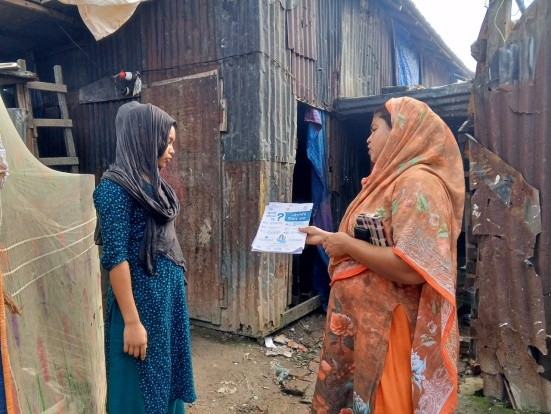
Peer educators recruited by AVAS conducted door-to-door visits across various wards of Barishal City Corporation and identified 860 adolescent girls aged 9–14 years. These included girls who had dropped out of school, were at risk of engaging in sex work, and those belonging to the Manta community.
During the listing process, it was observed that some girls lacked birth registration cards; AVAS provided assistance to help them obtain the necessary documentation.
Courtyard meetings were conducted with the guardians of adolescent girls from underserved slum areas and the Manta community to address concerns surrounding HPV vaccination.
These sessions were essential, as many guardians initially expressed hesitancy due to widespread misconceptions, including fears that the vaccine could cause infertility or affect their daughters' marriage prospects.
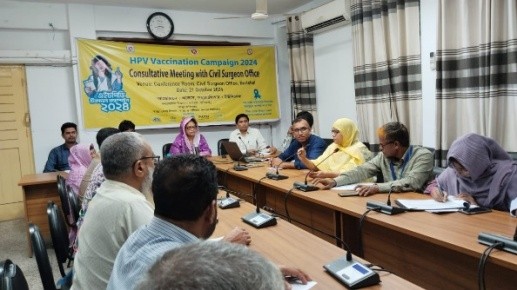
Prior to the launch of the vaccination campaign, consultation meetings were organized with key stakeholders, including representatives from the Civil Surgeon's Office, Health Department, Barishal City Corporation, and heads of educational institutions.
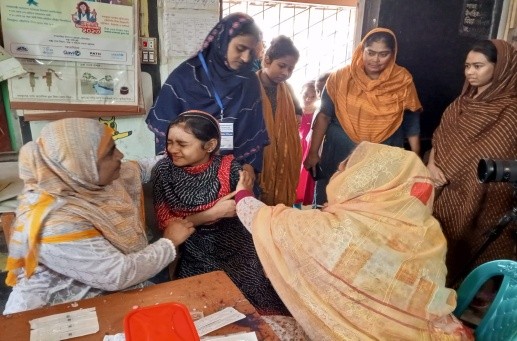
On the scheduled vaccination dates set by Barishal City Corporation, AVAS peer educators played a vital role in ensuring the participation of the listed adolescent girls. They conducted door-to-door mobilization, escorted the girls to the designated vaccination camps, and provided on-site support.
Results & Accomplishment
Challenges & Strategic Solutions
Challenge
Widespread misconceptions, particularly the belief that the HPV vaccine causes infertility, led to initial resistance among parents and guardians.
Solution
Conducted courtyard meetings and engaged in one-on-one communication with adolescent girls and their guardians to raise awareness and build trust.
Challenge
Reaching out to out-of-school adolescent girls posed difficulties due to their mobility and lack of regular contact points.
Solution
Collected detailed data through household visits to identify and list eligible girls for vaccination, maintaining regular follow-up with local councilor's office.
Challenge
Adolescent girls from the Manta community, who remain socially and geographically isolated, were difficult to access and engage.
Solution
Collaborated with the Manta community leader (Sardar) to communicate the health benefits of the HPV vaccine, gaining community support.
Key Learnings
The HPV vaccine is a safe and effective tool for the prevention of cervical cancer.
Vaccination is most effective when administered between ages 9 and 14.
Awareness campaigns and family support are critical factors in ensuring vaccine acceptance and uptake.
Join Our Collective Voice
Would you like to share your Organization's upcoming events?
Share Upcoming EventCo-financing policy
Co-financing means that countries contribute to the cost of Gavi-supported vaccines by financing some of the required vaccine doses.
Download PDFFramework for Gavi Funding to Countries
The purpose of this document is to set out the objectives, principles and approach for Gavi funding to eligible countries.
Download PDF