
An Overview of Participants, Organisations and Geographies
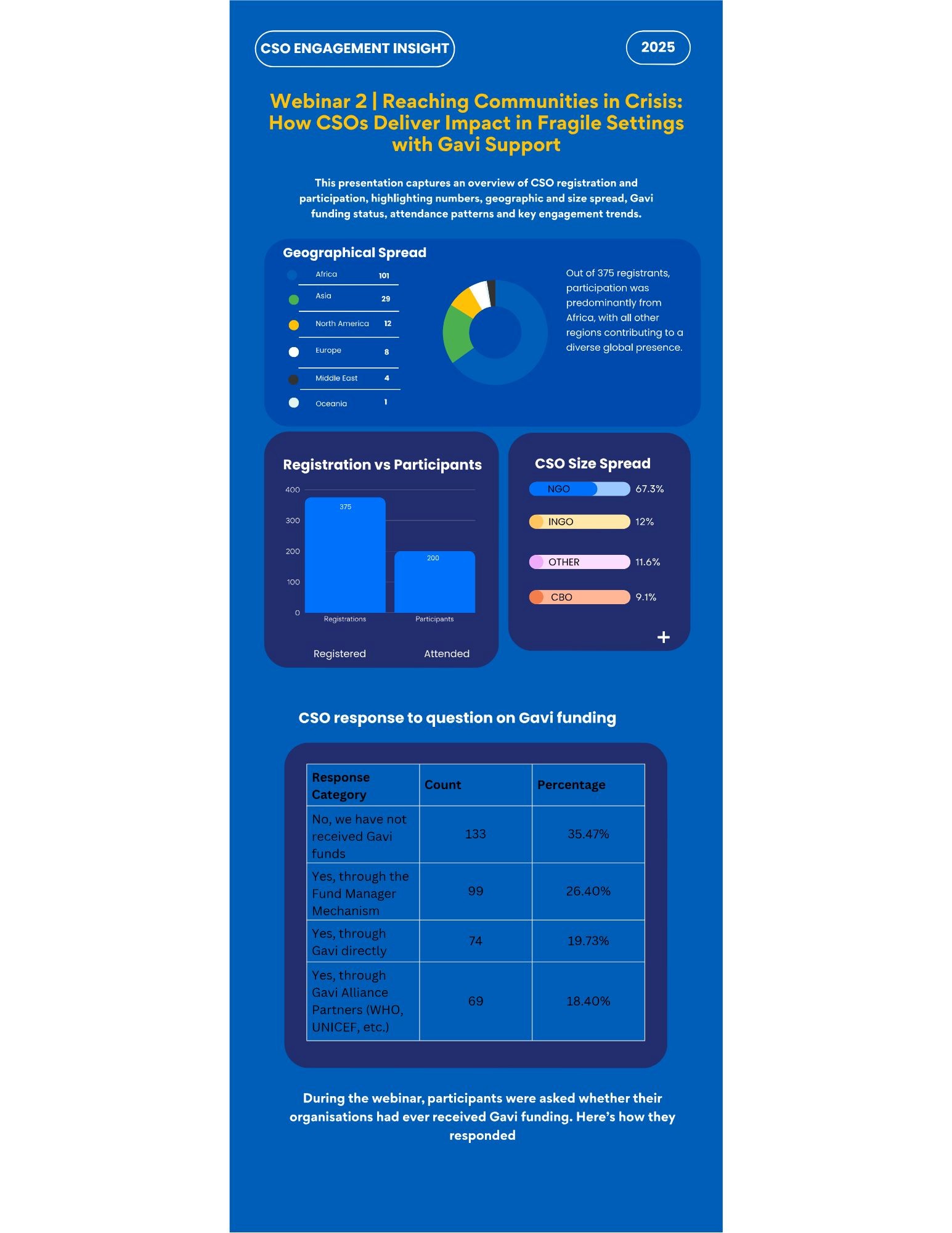
The above infographic indicates various aspects of the webinar as follows:
- Participation: Out of 375 registrations, 200 participants attended the call.
- Type of Organisations: The webinar witnessed participation from a wide variety of organisations including International NGOs, NGOs with regional networks and Community based Organisations.
- Geographical spread: Most participants were from Africa with organisations also participating from Asia, Africa, North America, Europe, Middle East and Oceania.
- Summary of participant responses on receiving Gavi funding: The webinar received a total of 375 registrations representing 155 organizations worldwide responded to the question. Of these, 242 participants reported having received Gavi funds. Among them, 74 participants indicated direct funding from Gavi, 69 received funding through Gavi Alliance partners, and 99 obtained funds via the Fund Manager mechanism. In contrast, 133 participants stated that they had not received any funding from Gavi.
Opening Remarks
The webinar aimed to inform CSOs on Gavi’s strategies for engaging in fragile settings and to hear directly from organizations working in conflict-affected contexts. Kirsten Gagnaire welcomed participants to the second in a series of CSO webinars, highlighting the consultation process as a platform for dialogue and feedback during Gavi’s transition from its 5.0 to 6.0 strategy, where CSO engagement remains central.
Kirsten emphasized that this present webinar would focus on CSO engagement in fragile and humanitarian settings, aiming to share Gavi updates, amplify CSO voices, and ensure that their lessons and recommendations directly inform Gavi’s operational approaches. She stressed that Gavi seeks to hear from CSOs on their experiences to shape implementation of the Gavi 6.0 strategy.
Dr. Bvudzai Magadzire, Gavi CSO Board representative and Director of Partnerships at VillageReach, highlighted the immense challenges CSOs face in fragile settings, pointing to examples from Gaza and Sudan where vaccine access has been severely reduced. She commended the resilience and determination of CSOs working under such conditions and informed participants that in July 2025, the Gavi Board approved its first dedicated Fragile and Humanitarian Approach, representing the Alliance’s largest-ever investment in these contexts.
Dr. Bvudzai praised the inclusive consultation that shaped the new framework, noting CSO voices were reflected, but mentioned that success depends on effective implementation. Despite funding constraints, she stressed that fragile settings remain a Gavi priority and framed the guiding question: what will it take for Gavi and CSOs to sustain immunization in crises while also building resilience for the future?
“Every child that is reached in this (fragile) context is the result of the determination, the courage, and the persistence that many of you on this call carry.”
— Dr. Bvudzai Magadzire, Gavi CSO Board Representative and Director of Partnerships at VillageReach
Setting the Scene: Gavi’s Strategic Shift for Fragile Contexts in 6.0
Clara Rudholm, Gavi’s Senior Manager for Civil Society and Community Engagement, outlined Gavi’s position on Gavi’s approach to fragile/conflict-affected and humanitarian contexts in the Gavi 6.0 strategy.
Clara Rudholm explained how the Board’s decision fits into Gavi’s wider strategic direction. In the past five years, Gavi had deliberately strengthened engagement in fragile and conflict settings, partnering with over 200 CSOs from large NGOs to local community actors. These organizations have proven critical in expanding outreach, negotiating access, supporting cross-border work, and building trust where governments cannot operate alone.
Gavi 6.0, emphasizes three priorities for fragile settings:
- Equity (reaching zero-dose children concentrated in fragile settings)
- PHC integration (linking immunization with services like nutrition, WASH, and family planning)
- Operational flexibility (accepting higher costs per child and adapting modalities).
These lessons align with the Lusaka Agenda shifts and will guide the Fragile and Humanitarian Approach going forward, ensuring that fragile contexts remain at the center of Gavi’s next strategy.
CSOs bring unique values – expanding service delivery, building trust with communities, supporting mobile and outreach services, and negotiating access in areas where governments or other partners cannot operate. In many cases, CSOs have ensured vaccines reach displaced or cross-border populations who would otherwise be left behind.
Clara noted that while Gavi’s model is government-led, the mandated allocation of at least 10% of Gavi support to CSOs has created space for their meaningful involvement, including in fragile areas. Complementary mechanisms, such as the Zero-Dose Immunization Programme (ZIP), have also helped extend immunization where state systems cannot reach the last mile.
Looking ahead to 6.0, supporting CSOs in fragile contexts will remain a central priority. This requires flexibility to adapt operations, acceptance of higher costs per child, and stronger integration with other services like nutrition and WASH. These lessons form the foundation for Gavi’s new Fragile and Humanitarian Approach, ensuring that zero-dose and under-immunized children in crisis settings are a strategic focus going forward.
Country and CSO Spotlights
1. Palestine Red Crescent Society (PRCS), Gaza
Speaker: Dr. Bashar Murad, Head of Primary Healthcare Services in Gaza, supported by Tasneem Obaid (who finished the presentation during connectivity issues)
The PRCS team sustain immunization in Gaza despite severe humanitarian challenges. Using fixed sites, temporary points in shelters, and mobile clinics, they coordinate with OCHA and ICRC for safe access, while volunteers drive awareness and demand. Despite destroyed facilities and security risks—including staff losses—they continue routine immunization, support polio response, and integrate vaccines with services like nutrition and family planning.
Achievements:
- Reached 17,013 children with at least one vaccine dose in four months.
- Delivered 20,000+ antigens (including PENTA, polio, and measles vaccines).
- Conducted 40 immunization awareness sessions in IDP sites.
- Played a critical role in three polio campaigns, achieving 100% coverage in their operational areas despite limited access windows.
2. SANRU (Soins de Santé Primaires en Milieu Rural), Democratic Republic of Congo
Speaker: Dr. Lala Assy,Project Lead, Vaccination, APEC, (a local implementing partner under SANRU in the DRC)
SANRU’s works in the Democratic Republic of Congo (DRC) through its sub-recipient APEC. Their projects are designed to reduce inequities in immunization coverage, particularly focusing on reaching zero-dose children in fragile and hard-to-reach provinces. SANRU’s approach combines community-based strategies with close coordination with the Ministry of Health, while also mobilizing local actors to improve demand generation and strengthen service delivery.
Achievements:
- Significantly contributed to reducing the number of zero-dose children in targeted provinces.
- Deployed community health workers and volunteers to identify unvaccinated children and link them to services.
- Improved coordination with local health authorities for planning and delivery of immunization.
- Supported integrated health services that combined immunization with other essential interventions.
3. Save the Children, Sudan
Speaker: Dr. Bashir Kamal Eldin, Health and Nutrition Director
Save the Children operates across 10 of Sudan’s 18 states, leading a consortium with Alliance and IMC to strengthen immunization and reach zero-dose children despite active conflict and severe access challenges. Save the Children works closely with the Ministry of Health at national and subnational levels, supporting health facilities, training workers, and engaging communities. Their efforts have focused on sustaining services during conflict, reaching hard-to-access populations, and combating vaccine hesitancy with tailored messages.
Achievements:
- Reached over 460,000 children with vaccines in nine months of 2025.
- Identified and vaccinated 125+ zero-dose children during this period.
- Trained more than 800 health workers and supported over 1,600 immunization sites.
- Improved coverage rates, with Penta 1 vaccination rising from 47% to 71% within six months.
Dialogue: Making Fragile Context Collaboration Work
Facilitator-led group discussion & Mentimeter input
Mentimeter prompts and responses:
1. What is the biggest challenge your CSO faces when delivering immunisation in fragile or humanitarian settings?
Key Themes:
- Access and Security – Safety concerns, security of health workers and patients, negotiating access with authorities and communities, and accessibility issues (to reach the last mile) due to conflict or instability.
- Cold Chain and Logistics – Maintaining vaccine cold chain and potency, lack of cold chain equipment and long distances between communities and immunisation sites.
- Data and Information Systems – Difficulty in data collation and collection, lack of access to data, contextualized data collection tools and alignment with the government.
- Community Trust and Engagement – Lack of trust within communities, community awareness about services, anchored community dynamics in the region, and need for stronger community engagement.
- Resources & Sustainability – Adaptation of funds to regional needs, sustainable service delivery models, risk prediction, flexible financial resources and funding.
2. What’s one operational change Gavi could make to better support fragile-context CSOs in 6.0?
Key Themes:
- Flexible and Adaptive Funding – Flexible funding, adaptive financing models, anticipatory funding, ability to shift money between budget lines, funding other humanitarian packages (integrating immunisation with other packages – nutrition, PHC).
- Direct funding support to CSOs – to local partners, funding for CSO engagements, support for OSC locales in fragile contexts.
- Engagement and Coordination – Greater recognition/CSO engagement at international levels, better coordination with governments/stakeholders, cross learning and platform development for humanitarian access.
- Capacity Strengthening – on information management systems, MEL frameworks, log-frames, implementation in fragile context and technical support.
- Monitoring, Evaluation and Accountability – adaptive MEL frameworks reflecting fragile realities, gender- transformative MEL, dynamic fragility indicators and metrics
3. Provide one word to describe how Gavi can strengthen alignment with CSOs in humanitarian coordination structure
Key Themes:
- Communication and Dialogue: Emphasis on open, two-way engagement between Gavi and CSOs.
- Trust and Partnership: Highlights the need for mutual respect, accountability, and stronger partnerships.
- Flexibility and Adaptability: Need to adapt to humanitarian realities and remain flexible.
- Empowerment and Advocacy: Calls for strengthening CSO voice and role in humanitarian coordination.
- Coordination and Integration: Desire for better integration of CSOs in systems and coordination platforms.
Overall Takeaways:
Across all questions, participants consistently called for:
- Flexibility — both in funding and in adapting to fragile contexts.
- Direct support and recognition of local CSOs across funding, engagement, and coordination.
- Communication, trust, and partnership – between Gavi and CSOs to deliver results.
- Operational challenges (security, cold chain, data) remain significant but solvable if systemic changes (funding models, coordination, capacity building) are addressed.
- Integration with broader humanitarian needs (nutrition, mobile outreach, anticipatory response) reflects CSOs’ push for holistic and context-sensitive approaches.
Gavi Board Updates and 6.0 Fragile – Settings Focus
Key July Board decisions affecting CSOs and fragile contexts
Dr. Bvudzai Magadzire presented the key July Board decisions, highlighting the continued prioritisation of fragile and humanitarian settings, the extension of ZIP, and sustained CSO funding opportunities under Gavi 6.0.
The Board reaffirmed that CSOs are critical partners in reaching zero-dose children in these settings and confirmed the continuation of the Zero-Dose Immunisation Programme (ZIP), with adjustments planned to refine its focus and structure. Importantly, the Board also endorsed the continuation of dedicated CSO funding calls, ensuring that local organisations will have access to opportunities such as the recent Nigeria call for proposals, with Cameroon CSOs already engaged.
Dr. Bvudzai further highlighted the need for Gavi to strengthen operational readiness in fragile contexts, particularly by improving preparedness before crises and enabling more adaptive, rapid responses when emergencies escalate. Resource constraints remain a challenge, as Gavi must balance its focus on zero-dose children with a broader health system strengthening investments. Leadership has been tasked with finding ways to mitigate these funding gaps, while ensuring that fragile and conflict-affected settings continue to receive targeted attention under Gavi 6.0.
Gavi 6.0’s operational model for fragile and humanitarian settings
Amy Ratcliffe, Technical Lead, ZIP Humanitarian Grants Portfolio at Gavi, provided a deep dive into how Gavi 6.0 will operationalise its approach in fragile and humanitarian contexts, underscoring the need to adapt strategies to reach zero-dose children in the most complex environments.
The Zero-Dose Immunisation Programme (ZIP) will continue into the next phase, with adjustments to its focus and structure to ensure better alignment with country realities. The Accountability Advisory Group (AAG) would be engaged in the operationalisation process, while participants suggested that the Humanitarian Listen & Learn sessions should also be integrated to capture the perspectives of frontline actors.
While the importance of preparedness and agility is central to Gavi’s work, there is a need to put mechanisms in place that allow for better anticipation of crises and more rapid responses when situations deteriorate. Flexibility is vital, particularly in conflict-affected areas where service delivery can change overnight. The operational model aims to better account for these fragile dynamics and adapt funding, delivery, and monitoring accordingly.
Gavi will continue to focus on balancing the dual priorities of reaching zero-dose children and strengthening health systems under constrained budgets. While funding shortages remain a challenge, Gavi is committed to keeping fragile and humanitarian settings central to its strategy and will continue to explore innovative ways of bridging these gaps. Gavi 6.0 seeks not only to maintain immunisation coverage in difficult contexts but also to strengthen collaboration with CSOs as key partners in delivering services where government reach is limited.
CSO engagement on Zoom: Question and Answers
The Q&A session centered on Gavi’s Fragile and Humanitarian Approach and how it will be implemented. Participants raised questions about ongoing consultation in operationalization, with Gavi confirming that the Alliance Advisory Group and wider partners would remain engaged. There was also strong interest in funding access, with CSOs asking how to participate in Gavi’s mechanisms in conflict-affected areas such as northern Nigeria. Gavi explained that competitive calls for CSO proposals would soon be published on its website under the fund management mechanism.
Other questions highlighted field-level challenges. Additional questions for CSOs in Gaza and Sudan focused on maintaining services amid insecurity and displacement but were deferred to the chat due to time. Overall, the discussion reflected CSOs’ interest in practical funding opportunities and strategies for sustaining immunization in fragile contexts.
Questions that received responses
1. Will partners be consulted on the operationalization of the Fragile and Humanitarian Approach in 6.0?
- Response: Yes. The Alliance Advisory Group (AAG) that helped shape the approach will continue to be consulted throughout operationalization. They are meeting next week to review the new Fragile Emergencies and Displacement (FED) policy, which creates flexibility within Gavi. Once Gavi finalizes standards, they will also seek broader partner feedback to refine the process.
2. How can my organization access Gavi funding in insurgency-affected areas of northern Nigeria? I’ve tried to register but haven’t been added to the Gavi portal.
- Response: Funding cycles and mechanisms vary. In Nigeria, there will soon be a call for CSO proposals, published on Gavi’s website. This is part of a fund management mechanism linked to the government’s application to Gavi, which includes a CSO funding portion. The process will be competitive, and information will be shared on the Gavi site.
3. (To SANRU/APEC – DRC): How did you negotiate access to blocked or insecure areas?
- Response: (SANRU/APEC- DRC): There were no formal negotiations. Instead, SANRU relied on community dynamics and structures already in place. Local leaders and members were engaged to take responsibility for safety and surveillance. Community registers helped identify households, and during this process, children without vaccination were identified and referred to services.
4. How has the cold chain not been affected by the crisis?
- Response: The Cold chain is maintained through PEV staff and trained nurses.
5. Did SANRU mobilize religious leaders or faith communities?
- Response: Yes, faith leaders were trained in HCD and mobilize communities through churches and workshops.
6. Do you use motivation mechanisms for beneficiary participation?
- Response:
- Provided funds for income-generating activities.
- Vaccinators from local community + use of local leaders; involvement builds ownership.
7. Do your teams go in directly or work through local CSOs/CBOs?
- Response: We work through MOH staff and community volunteers with supervision.
8. How do you manage beneficiaries’ reluctance, especially in conflict?
- Response: Using community vaccinators and leaders; community involvement fosters ownership.
9. Will the ZIP program continue with Gavi 6.0 funding?
- Response: Yes, expected to continue, with adjustments to focus and structure.
10. Could Humanitarian Listen & Learn sessions be involved in operationalization?
- Response: Noted as input for consideration.
11. Where can one find information on the Nigeria Call for Proposal?
- Response: Here is the link to the Call. It will be updated soon on the link.
12. Any site for Cameroon call for proposals?
- Response: All calls posted on website; Cameroon CSOs already identified and implementing.
13. How are you ensuring the safety of your teams in unpredictable attacks?
- Responded to partially: Motivation mechanisms
Questions which did not receive a response
- Comment avez-vous pu conduire la négotiation d’accès auprès des groupes non-étatiques pour pénétrer les zones sous blocus?
- Who provided vaccination services for identified children, and how did CSOs facilitate access in difficult zones?
- Quelle stratégie pour convaincre les chefs religieux d’adhérer au projet et renforcer la mobilisation communautaire?
- How do you ensure continuity of vaccination when the security situation deteriorates?
- What mechanisms can Gavi put in place for preparedness before crises and rapid response when situations deteriorate?
- With funding shortages, how is Gavi leadership mitigating challenges while focusing on zero-dose and HSS?
- NGOs in Yemen require stronger support and advocacy from Gavi toward the internationally recognized Government — how will Gavi ensure greater CSO engagement?
Note: A separate document with details of the above-mentioned questions, who asked these questions and to whom it was directed have been shared with Kati Collective and the Gavi Secretariat to collect responses from the respective presenters who participated in the webinar. The answers will be added once the responses are received.