
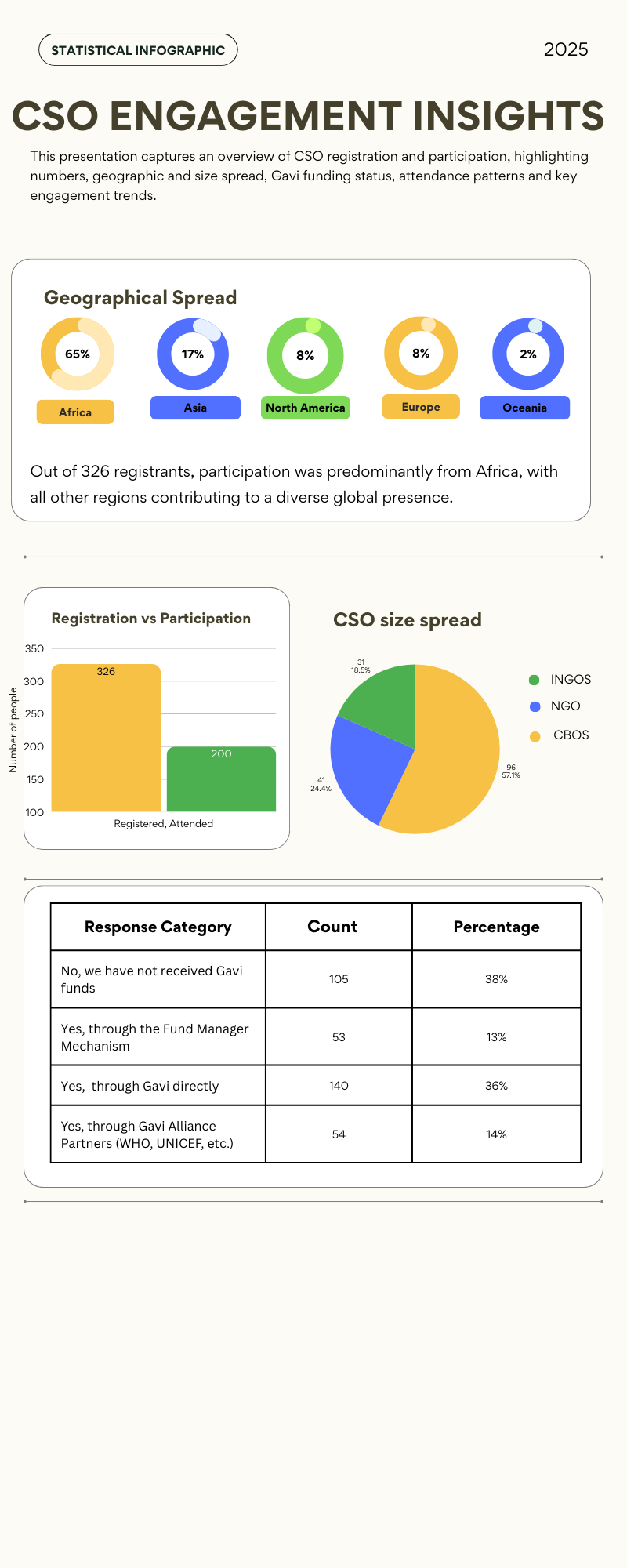
Opening Remarks
The purpose of this webinar was to foster a two-way dialogue between Gavi and civil society organizations as the partnership moves from Gavi 5.0 to 6.0. The opening remarks were given by Kirsten Gagnaire, CEO of Kati Collective and the moderator of the webinar.
Strengthening CSO integration within national health systems, improving mapping of CSO activities — especially in indirect support roles — and reinforcing monitoring and learning systems were highlighted as critical to ensuring CSO contributions are documented, recognised, and used to inform decision-making at both national and global levels.
Dr. Bvudzai Magadzire, Gavi CSO Board Representative and Director of Partnerships at VillageReach emphasized the need to understand pathways in which CSOs work with Gavi, how CSOs are funded, and structurally embedded in health systems to enhance long term resilience. The session underscored the need for CSOs to work more intentionally with government structures, moving beyond parallel efforts to collaboratively strengthen public health systems.
The need for better visibility, mapping, and coordination of CSO activities, especially when working through indirect channels, was highlighted, to improve collaboration and effectiveness. It reflected the need for strengthening results monitoring and learning systems to clearly reflect CSO contributions, especially since Gavi has ring-fenced funding for CSOs and accountability therefore becomes essential.
“While progress has been made, zero-dose children remain a persistent challenge, especially in remote and marginalised communities. CSOs are uniquely positioned to bridge service gaps, drive community trust, and address vaccine hesitancy.”
— Dr. Bvudzai Magadzire, Gavi CSO Board Representative and Director of Partnerships at VillageReach
Gavi’s Vision for CSOs in Health Systems
Clara Rudholm, Gavi’s Senior Manager for Civil Society and Community Engagement, outlined Gavi’s position on CSO engagement under the forthcoming 6.0 strategy. The Gavi Board’s decision mandates significantly increased engagement with CSOs. This commitment was not only about providing more funding but also about defining clear mechanisms and strategies for how that engagement would take place.
CSOs are positioned as critical partners in three strategic areas: complementing service delivery in hard-to-reach areas, engaging communities to drive demand, and advocating for equitable access and sustainable financing.
The Gavi Board’s commitment to the CSO platform and the CSO Fund Manager will remain central in 6.0, with both mechanisms strengthened to expand opportunities for smaller, local organisations. Planned measures include reducing compliance barriers and enhancing CSO participation in health system planning and delivery, ensuring their contributions are embedded in the design and execution of immunisation strategies.
Country and CSO Spotlights: ALIMA Mauritania
In Mauritania, ALIMA used mobile health teams and flexible service schedules to reach nomadic and remote communities. By integrating immunisation with maternal and child health services and working closely with the Ministry of Health, the organisation improved access, reduced zero-dose rates, and built long-term community trust.
Achievements:
- Increased immunisation in remote desert and rural areas.
- Reduced zero-dose rates among nomadic populations.
- Combined vaccination with maternal and child health services.
- Built community trust and trained local health workers.
Country and CSO Spotlights: Red Cross Sierra Leone
The Sierra Leone Red Cross described its efforts to integrate CSOs into district health management systems across five districts. Community-based volunteers were deployed to identify and connect zero-dose and under-immunised children with vaccination services.
Achievements:
- 1,891 zero-dose children vaccinated.
- 1,342 hard-to-reach communities served.
- Capacity building for volunteers and health workers.
- Strengthened DHMT partnerships and demand generation.
Country and CSO Spotlights: CCRDA Ethiopia
CCRDA’s project targeted Ethiopia’s pastoralist border communities using a fully government-integrated model. Working in close partnership with local health authorities, the organisation leveraged real-time data systems to pinpoint immunisation gaps, restore vital infrastructure, and coordinate outreach.
Achievements:
- Reached over 46,000 households, identifying 11,000 zero-dose children.
- Restored cold chain functionality in six remote facilities.
- Reached 26,000 zero-dose children through targeted outreach.
- Achieved 47% Penta 3 coverage among under-fives in targeted areas.
Mentimeter Dialogue: What Makes CSO Integration Real?
Facilitator-led group discussion & Mentimeter input
Mentimeter prompts and responses:
42 participants
What kind of support does your CSO need most to be taken seriously as a partner in the health system?
Key Themes:
- Advocacy & Policy Engagement – Support for high-level advocacy with governments and donors, inclusion in policy dialogue, and representation in planning processes.
- Capacity Strengthening – Training, technical assistance, and organisational development to improve effectiveness.
- Visibility & Recognition – Mechanisms to showcase CSO contributions in government reports, dashboards, and data systems.
- Collaboration & Partnership – Stronger coordination with Ministries of Health and local governments, participation in joint planning and supervision.
- Resources & Tools – Access to funding, mobility for hard-to-reach areas, and data management systems.
What is one thing Gavi could change to work better with CSOs?
Key Themes:
- Funding – More direct funding to CSOs, timely disbursements, and transparency on indirect costs.
- Simplified Processes – Easier reporting, streamlined monitoring frameworks, and less administrative burden.
- Capacity Building – Support for advocacy, technical delivery, and sustainability.
- Partnership Approach – Continuous collaboration, inclusion in planning, and stronger feedback mechanisms.
What has helped your CSO work more closely with government health teams?
Key Themes:
- Alignment with Government Priorities – Adapting to national policies and strategic plans.
- Strong Relationships – Networking, trust-building, and effective communication.
- Collaboration Mechanisms – Joint planning, monitoring, and technical assistance from Gavi country teams.
- Recognition & Inclusion – Being acknowledged as partners, not competitors, and having a seat at the planning table.
- Demonstrated Value – Showing impact and added value through data and success stories.
How can we better show the impact of CSOs in national health plans or data?
Key Themes:
- Representation in Data Systems – Inclusion of CSO contributions in national, provincial, and district health data.
- Capacity for Data Collection & Use – Training, resources, and tools to collect, analyse, and report high-quality data.
- Regular Engagement – Participation in Ministry of Health review meetings and integrated planning processes.
- Visibility Platforms – Use of Gavi platforms, newsletters, and public reporting to highlight CSO impact.
- Collaborative Learning – Sharing best practices, peer exchange, and joint planning to strengthen collective impact.
Overall Takeaways:
Across all questions, participants consistently called for:
- Recognition & Visibility – CSOs want to be acknowledged as integral system partners, with their work reflected in official data and policy discussions.
- Resources & Capacity – Sustained funding, training, and technical support are critical for impact.
- Integration & Collaboration – Inclusion in planning, coordination, and monitoring at all levels of the health system.
- Simplification & Flexibility – Streamlined funding and reporting processes to enable more focus on delivery and outcomes.
Gavi Board Updates and 6.0 Strategic Shifts – Dr. Bvudzai Magadzire
The Gavi Board reaffirmed the central role of CSOs in achieving immunisation goals and reaching zero-dose children, particularly in underserved communities. The Board committed to sustaining and strengthening CSO engagement during the transition from Gavi 5.0 to 6.0, with a clear endorsement to maintain the CSO platform and the CSO Fund Manager as core support mechanisms.
Key outcomes relevant for CSOs:
- Reductions across all Strategic Goal areas.
- Minimum 10% ringfencing for CSOs retained; to be applied to the consolidated cash grant.
- Fragile & humanitarian support retained, with a reduction in budget.
- Global/Regional Solutions Fund (previously SFA) retained.
Overview of Gavi 6.0 Strategic Shifts – Pooja Jose - Sr. Manager Strategic Design and Delivery
Clara explained that the Gavi 6.0 strategy represents an evolution rather than a revolution, building on the progress made in Gavi 5.0 but introducing important shifts to accelerate impact.
Key shifts include:
- Integration with primary health care – embedding immunisation within broader health systems rather than operating as a stand-alone programme.
- Stronger equity focus – targeting zero-dose and under-immunised children in the most marginalised and hard-to-reach areas.
- Greater country leadership – enabling national governments to take ownership of programme planning, financing, and delivery.
- Context-specific approaches – tailoring support to regional needs and realities.
- Partnerships with civil society – to strengthen demand generation, community engagement, and advocacy.
- Enhanced use of data and evidence – to inform decisions, monitor progress, and adjust implementation in real time.
Zoom: Question and Answers
CSOs actively engaged in the Zoom session, raising numerous questions on topics such as data, new terminologies, the meaning of “scale-up”, funding cuts, and other related areas. They demonstrated strong interest in learning from country-level experiences and in understanding practical approaches for integrating their work with government health systems. Participants were particularly keen to explore the potential implications of funding cuts and to identify effective ways to collaborate with Gavi under the 6.0 strategy.
The following section presents the questions submitted by participants in the Zoom chat. While several were addressed during the session by both participants and the Gavi Secretariat, a few remained unanswered. As a next step, these unanswered questions could be addressed and shared with participants via email following the webinar.
For Sierra Leone: Did you have target estimates for Zero Dose Children and Under-Immunized Children? How did you arrive at this?
- Yes, using ZDC percentage from each region.
Clarification on “Kebele”
- It refers to the last and lowest government administrative structure in Ethiopia.
What does “scaling up vaccines” mean?
- Improving coverage of vaccines already introduced in a country.
What is “Gavi Leap”?
- A key phrase used by Gavi to describe the shift from Gavi 5.1 to 6.0 — a big leap forward in the next strategic period.
Strategies for CSOs to optimize field actions?
- Differentiated investments starting with the health systems strategy and moving to detailed Programme Funding Guidelines (coming January 2026).
Can you explain cuts to Gavi vaccine programmes?
- The recalibration summary is still being finalized; details expected closer to September.
Can CSOs receive new funding during an ongoing grant?
- Yes.
What type of support does your CSO most need to be taken seriously as a partner in the health system?
- The type of support that CSOs need is to continue strengthening the capacity of these actors, supporting advocacy, and providing monitoring guidance.